Construction drawings
Construction Drawing Guide: Everything From A to Z
Snel Kwaliteit Tekenwerk3 November 202511 min readupdated 24 June 2026
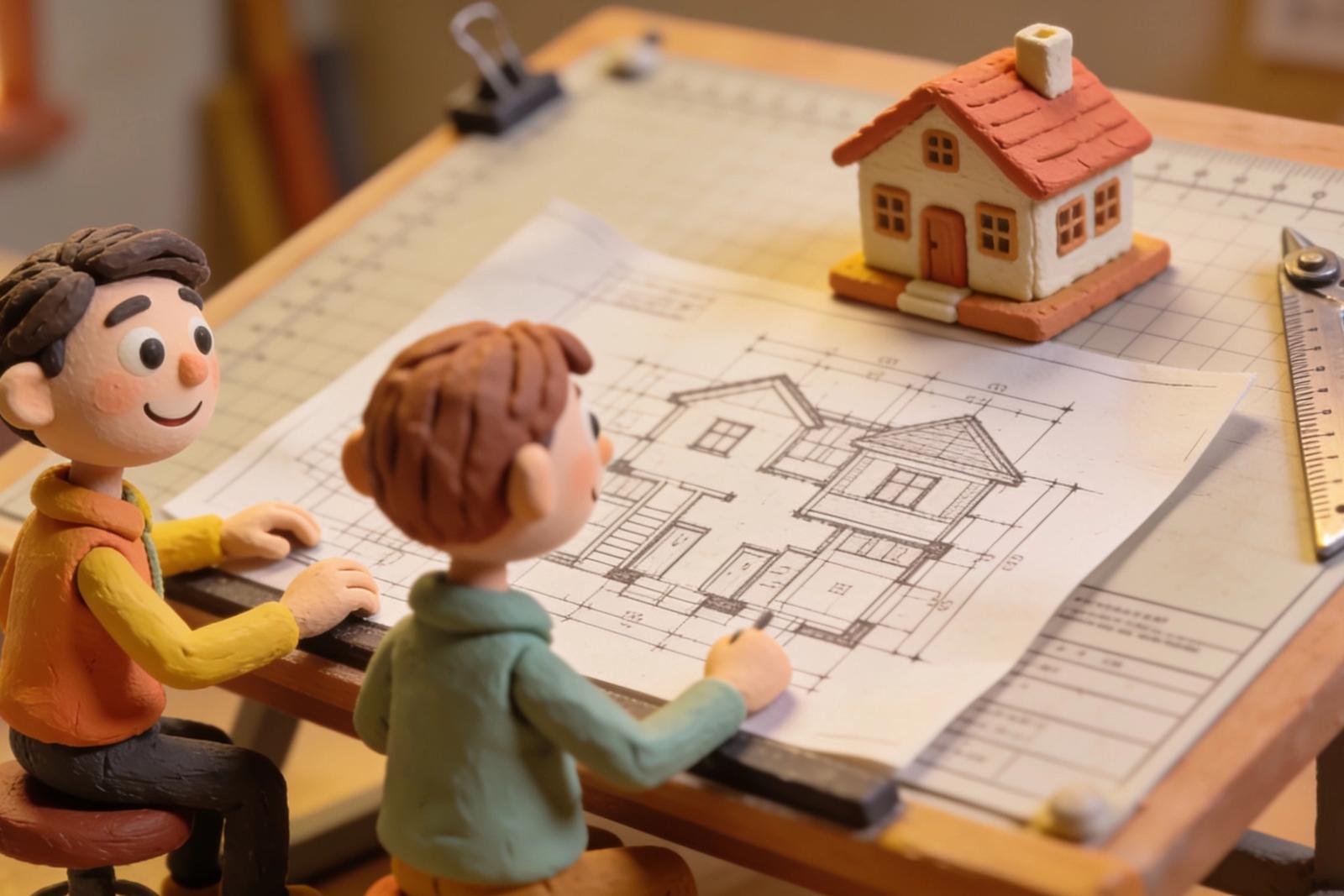
Getting a construction drawing made means hiring a technical drafting firm. They survey your property, translate your wishes into permit-ready drawings, and support your permit application. Average turnaround: two to four weeks. Costs: roughly 500 to 2,500 euros, depending on the project.
A construction drawing is the blueprint of every building project. Without accurate, complete drawings you cannot apply for a planning permit, and the contractor has no clear guide for what to build. Mistakes cost weeks of delay and thousands of euros. This guide covers everything you need to know: what a construction drawing is, which types exist, how the application process works, what it costs, and which mistakes to avoid.
What is a construction drawing?
A construction drawing is a detailed, true-to-scale technical drawing of a structure. It goes far beyond a sketch. A complete construction drawing includes all dimensions, materials, heights, and structural details needed for the execution and assessment of a building project.
The drawing serves three purposes simultaneously. For the municipality it is an official assessment document: they use the drawings to determine whether your plans fit within the zoning plan and the Building Decree. For the contractor it is an execution guide: they know exactly where walls go, how high the floors are, and which materials are used. For you as the client it provides certainty: you see what you will get before the first brick is laid.
What does a construction drawing contain?
A complete set of construction drawings for a permit application consists of:
- Site plan: 1:500 or 1:1000 · Position on the plot, distances to boundary lines
- Floor plans: 1:100 · Layout per floor, walls, doors, windows
- Elevation views: 1:100 · Exterior from all sides, heights, materials
- Cross-sections: 1:100 · Vertical build-up, floor heights, roof structure
- Detail drawings: 1:10 to 1:20 · Connections, window frames, foundation details
In addition to the visual elements, each drawing includes a title block with the client's name, address, drafting firm, date, and scale. A clear legend explains symbols and hatching. Dimensioning is complete: not just overall measurements, but also part dimensions of every structural element.
Types of construction drawings: from concept sketch to as-built drawing
During a building project you need different types of drawings. Each type belongs to a specific phase and purpose.
Concept sketch. The very first rough elaboration of your idea. No details yet, but layout and volume. Serves as the basis for discussion and decisions.
Specification drawing. The formal drawing for the permit application. Fully worked out with all dimensions, materials, and structural details. Also forms the contract document between client and contractor.
Working drawing. Much more detailed than the specification drawing. Intended for execution on the building site. Contains assembly instructions, exact connections, and technical specifications.
Detail drawing. Zooms in on a specific element: a roof edge, window frame connection, or foundation detail. Essential for complex connections.
As-built drawing. Made after construction. Shows the situation as actually built, including all changes made during construction. Essential for future renovations, maintenance, and sale.
Alongside construction drawings there are also structural drawings, which focus on the load-bearing structure: foundations, beams, and columns. For interventions in the load-bearing structure, structural drawings and accompanying calculations by a structural engineer are required. More information is available on our structural calculation page.
When is a construction drawing required?
Not every job requires drawings. Small permit-free interventions, such as a garden shed within certain dimensions, may proceed without a permit. But for the following situations a planning permit and therefore a complete set of construction drawings is always required:
- New construction of homes or outbuildings
- Extensions deeper than four metres at the rear facade
- Roof additions and front dormer windows
- Changes to the load-bearing structure
- Change of use
- Splitting or merging of dwellings
Not sure whether your project requires a permit? Use the permit check at omgevingsloket.nl. The line between permit-free and permit-required is sometimes narrow and depends on multiple factors at once.
The Environment and Planning Act: what changes for your construction drawing?
Since the introduction of the Environment and Planning Act (Omgevingswet), permit applications have been modernised. Applications now run entirely through the Omgevingsloket. Digital PDF files are required, with correct file names and metadata. Municipalities increasingly assess applications digitally, which speeds up the process for complete submissions.
The Act also strengthens the influence of local rules. Each municipality can impose additional aesthetic requirements: stricter colour choices, specific materials for listed buildings, or extra documentation in certain neighbourhoods. Always check local guidelines alongside national regulations. Read more on the planning permit page.
In terms of content, the Act sets stricter requirements for sustainability. Insulation values, ventilation, daylight, and energy performance must be demonstrated in the drawings. Drawings that complied with the old Building Decree are not automatically complete under the new legislation.
Step-by-step: getting a construction drawing made
Whether you are planning an extension, dormer, or full renovation, the process always follows the same steps.
Step 1: Inventory of wishes and requirements
Start by clearly defining your plans. What exactly do you want to achieve? Which spaces, functions, and dimensions do you need? Check the zoning plan for your plot via ruimtelijkeplannen.nl: what are the maximum building and gutter heights, the building coverage percentage, and the setback lines? This tells you immediately which limits apply.
Step 2: Survey the existing situation
For renovations, the current situation must be accurately mapped. The drafting firm visits on-site to take measurements. Errors in the survey translate directly into errors in the drawings. Existing archive drawings held by the municipality can serve as a supplement, but are always verified for accuracy. Existing construction drawings can be requested via our retrieval service.
Step 3: Concept sketch and consultation
Based on the survey and your wishes, the drafting firm produces a first concept sketch. This is the moment to make adjustments. Changes at this stage are inexpensive. Adjustments after the final drawing or during construction cost considerably more.
Step 4: Final construction drawing
After approval of the concept sketch, the drafting firm elaborates it into permit-ready drawings. All details are recorded: exact dimensions, materials, level points, structural elements, and the required drawing annotations. The drawings are internally checked for consistency between floor plans, elevations, and cross-sections.
Step 5: Regulatory check
Do the plans comply with the Building Decree, local aesthetic requirements, and the zoning plan? A professional drafting firm integrates this check into the drawing process. Elements such as minimum ceiling height (2.60 metres for living spaces), escape routes, ventilation, and fire safety are tested as standard.
Step 6: Submission to the municipality
Via the Omgevingsloket you submit the permit application with all required documents: construction drawings, site plan, any structural calculations, and energy performance calculations. The municipality carries out a completeness check within two weeks. With a complete application, the substantive assessment follows, which takes up to eight weeks under the standard procedure.
Step 7: Processing adjustments
Municipalities sometimes request supplementary information or minor adjustments. A good drafting firm processes these quickly. After the final permit is granted, construction can begin.
Costs of getting a construction drawing made
Costs are determined by complexity, scope, and the additional services you use. The table below provides guideline prices for the most common projects.
- Dormer window: 350 to 600 euros · 1 to 2 weeks
- Extension up to 20 m2: 600 to 1,200 euros · 2 to 3 weeks
- Extension 20 to 40 m2: 1,200 to 2,000 euros · 2 to 3 weeks
- Full renovation: 2,000 to 5,000 euros · 3 to 5 weeks
- New-build home: 2,500 to 8,000 euros · 4 to 8 weeks
Additional services, such as a structural calculation or energy performance calculation, are charged separately. Always request an itemised quote so you know what is included. Do not compare providers on price alone: a rejected permit due to incomplete drawings costs more than the initial saving.
Want an idea of costs for your specific situation? See the knowledge base article on construction drawing costs or request a quote directly at /offerte/.
Common mistakes and how to avoid them
The same mistakes keep appearing in permit applications in practice. The five most critical:
1. Incomplete dimensioning. Missing part dimensions, window heights, or floor heights result in immediate feedback from the municipality. Make sure every dimension that the contractor or municipality needs is on the drawing.
2. Drawings that do not match each other. If a wall is two metres wide on the floor plan but one and a half metres on the elevation drawing, the dossier is inconsistent. A professional drafting firm checks all drawings for mutual consistency.
3. Non-compliance with the zoning plan. A planned gutter height that is two centimetres above the maximum leads to rejection. Check the zoning plan before you start drawing.
4. Outdated existing situation as a basis. Properties are modified over the years without the original drawings being updated. Always work from a current survey.
5. Missing elevation or site plan. The municipality always assesses all facades for renovation applications. An incomplete set of drawings is not processed.
A construction drafting firm with experience in local municipalities knows these pitfalls and integrates the checks into their workflow. For complex projects: invest in quality at the start, and you avoid delays and revisions later.
Drawing yourself or outsourcing?
With programmes such as SketchUp or Floorplanner you can make basic sketches yourself. That is fine for a first idea or consultation with a drafting firm. But for a permit application, professional drafting is almost always necessary.
A construction drafting firm has knowledge of the Building Decree, the current NEN standards, and municipal guidelines. They carry professional liability insurance for errors in their work. And they deliver files that are immediately suitable for digital submission to the municipality, including the correct file formats and metadata.
At SK Tekenwerk we handle the complete drawings for the planning permit, from survey to final set. See our construction drawing service overview or request a quote at /offerte/.
Keep your construction drawings
After construction, your drawings are worth more than you might think. For future renovations they form the starting point. When selling, they give the buyer insight into the structure and layout. And during maintenance, the contractor knows exactly how pipes and load-bearing elements are placed. Store the approved drawings, any revision drawings, and the as-built drawing in a digital archive that is easy to find.