Construction drawings
Have Your House Drawn: What It Involves, What It Costs, and How It Works
Snel Kwaliteit Tekenwerk21 November 20258 min readupdated 24 June 2026
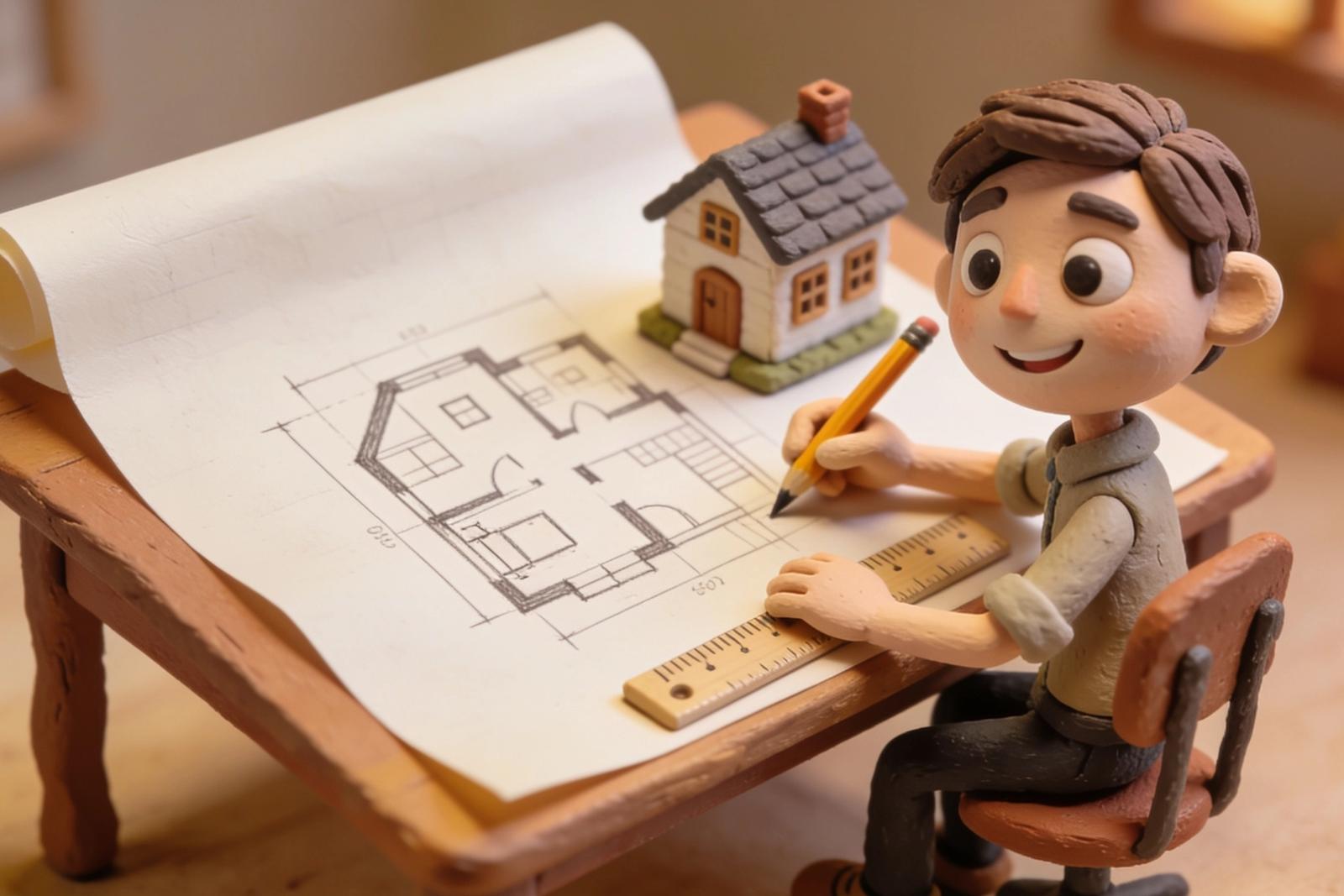
Having your house drawn means a construction drafter translates your living wishes into scale-accurate technical drawings. These are required for a planning permit, for the contractor, and for an accurate build budget. Costs range from roughly 350 euros for a dormer to 3,500 euros for new construction.
Every renovation or new-build plan starts on paper. But which drawing do you actually need, how does that drawing come about, and what can you expect in terms of costs and turnaround time? This article gives a complete overview: from the first sketch to the final construction drawing ready for the municipality.
Sketch versus construction drawing: what is the difference?
Many people start with a rough sketch on paper or in a simple programme like Floorplanner. Such a sketch is ideal for exploring ideas: you draw rough layouts, shift spaces around, and decide which setup best matches your wishes. A sketch has no fixed scale and contains no technical details.
A construction drawing is something quite different. It is a technical document drawn to scale, with dimension lines, a site plan, elevation views, and cross-sections. Municipalities only accept construction drawings for a planning permit application. Errors or missing elements lead to a request for supplementary information or an outright rejection.
The smartest approach: start with your own sketch to clarify your wishes, then have a construction drafting firm translate that into a formal construction drawing.
When do you need a drawing of your house?
Not every change to your property requires a drawing and a permit. Small interventions at the rear of a house can be permit-free under certain conditions. In most other cases a planning permit is required, and for that construction drawings are essential. Situations in which you almost always need a drawing:
- Front dormer window
- Extension or addition
- Roof addition or extra storey
- Property split
- New-build home
- Renovation involving removal of load-bearing walls
Not sure whether your plan requires a permit? Consult the Omgevingsloket or contact your municipality. Rules can vary per municipality and zoning plan.
What drawings are included in a complete building dossier?
A building dossier for a permit application typically consists of several components. Each component has its own function.
Site plan. A top-down view of the plot showing how your property relates to its surroundings, the boundary, and the public road. Required for virtually every permit application.
Floor plans. A top-down view per floor with the layout of spaces, placement of doors and windows, and the dimensions of all rooms. For a renovation you draw both the existing and the new situation.
Elevation views. The exterior of the house from four directions: front, rear, and both side facades. Elevation views show height, window arrangement, material choices, and roof shape. They are required for permit applications and are decisive for the assessment of the visual appearance.
Cross-sections. A vertical cross-cut through the building. This reveals floor heights, wall construction, and the relationship between floors and ceilings. Cross-sections are especially required for major renovations and new construction.
Structural drawings. Specialised drawings of the load-bearing structure: foundations, columns, beams, and load-bearing walls. Prepared by a certified structural engineer and required for new construction, roof additions, and extensions where structural work takes place.
Technical requirements: drawings at scale 1:100 or 1:50, with a title block containing project information, and submitted digitally via the Omgevingsloket in PDF or DWG format.
How does the process of having your house drawn work?
The journey from idea to submitted permit application typically proceeds in five phases.
Phase 1: Inventory of wishes. Write down what you want: number of rooms, layout, style, budget, and any special considerations. Make a first rough sketch and collect inspiration material. The clearer your brief, the fewer revision rounds will be needed.
Phase 2: Intake and concept sketch. A construction drafter discusses your wishes, reviews the existing situation, and produces a concept sketch. In this phase layouts are tested and practical choices are made, such as circulation routes, natural light access, and structural feasibility.
Phase 3: Elaboration into a construction drawing. The concept sketch is converted into a full construction drawing to scale. All required elements are added: dimensioning, elevation views, cross-sections, site plan. You give feedback and any revisions are incorporated.
Phase 4: Regulatory check. Before the drawings are submitted, they are checked against the zoning plan, the Building Decree, and municipal requirements. Missing calculations, such as ventilation or daylight calculations, are added.
Phase 5: Submission via the Omgevingsloket. The complete set of drawings and attachments is submitted digitally. The statutory assessment period for a standard application is eight weeks. With an incomplete application the municipality sets a correction period, which can considerably lengthen the process.
A typical turnaround for the drawing work itself: a dormer or small extension is ready in one to two weeks. A full new-build home takes four to eight weeks, depending on the number of revision rounds.
What does having a drawing of your house made cost?
The price depends on the project type, complexity, and number of drawings required. The figures below are guideline prices.
- Dormer window: 350 to 650 euros
- Extension or addition: 450 to 800 euros
- Renovation (larger): 500 to 1,200 euros
- Property split: 600 to 1,200 euros
- New-build home: 1,500 to 3,500 euros
- Structural calculations (extra): 300 to 600 euros
Factors that drive the price up: complex structural situations, a large number of floors, urgent submission, or the absence of existing floor plans requiring an on-site survey.
Three practical money-saving tips. Make sure your wishes are clear up front so the number of revision rounds stays limited. Supply existing material such as old floor plans or photos of the current situation. Bundle drawings and structural calculations with the same firm for an all-in rate.
Drawing yourself or outsourcing?
For exploring ideas, sketching yourself is useful and low-threshold. Programmes such as SketchUp, Floorplanner, and Sweet Home 3D are free or inexpensive and suitable for producing first floor plans.
For a formal permit application, strict technical requirements apply that self-made drawings rarely meet. Municipalities regularly reject applications due to incorrect scale, missing elevation views, or incomplete dimensioning. A rejected application means delay and extra costs for remedial work.
Hiring a professional is advisable in the following situations: for any permit-required renovation, for new construction, for structural work such as removing load-bearing walls, for listed buildings or protected townscapes, and for projects that deviate from the zoning plan.
How SKT helps with your building project
SK Tekenwerk (SKT) is a construction drafting firm specialising in producing complete construction drawings for permit applications. The firm works throughout the Netherlands and serves both private clients and professionals.
SKT handles the full process: from intake and concept sketch to final drawings and support during submission of the planning permit application. Structural calculations are provided in collaboration with certified structural engineers.
The approach: you fill in your project details, receive a clear quote, and SKT gets to work immediately. Turnaround times are short. For urgent applications a fast-track service is available.
Curious what a drawing of your house costs? Request a no-obligation quote at /offerte/ or view the services at /diensten/bouwtekening/.
Want to read more about related topics? See also the articles on applying for a planning permit and the explanation of construction drawings.